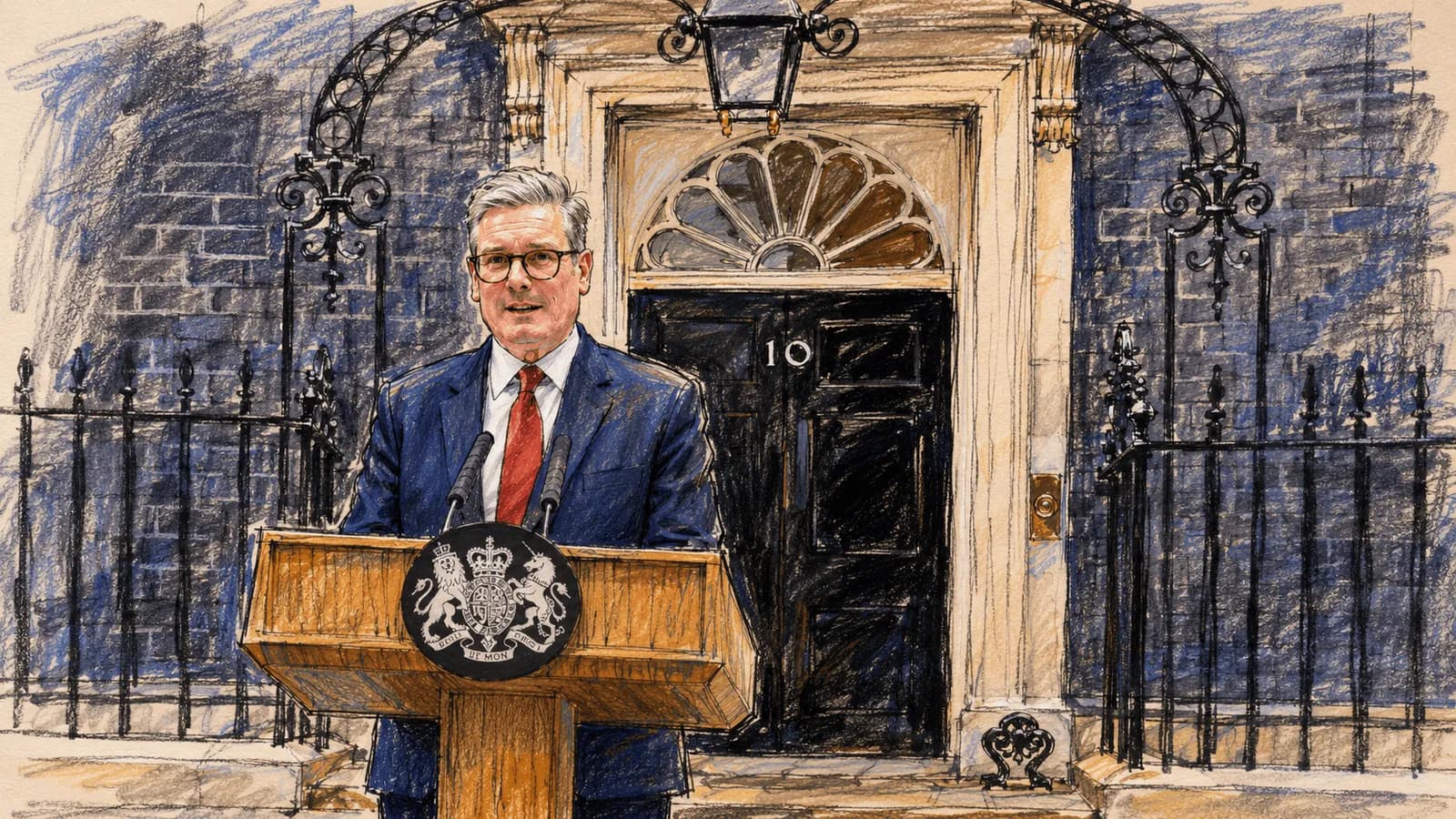
Keir Starmer has announced that he will resign as Prime Minister and leader of the Labour Party, bringing to an end a premiership that began with a historic Labour victory in July 2024 and now moves into an orderly transition of power.
Starmer is expected to remain in Number 10 until a successor is chosen, avoiding an immediate vacuum at the heart of government. For Westminster, the announcement marks a major political turning point. For the country, it opens a broader question: how can Britain move forward with stability, confidence and a renewed sense of purpose?
A Premiership Defined by Discipline and Delivery
Starmer entered Downing Street promising seriousness after years of political turbulence. His central offer was not revolution, but repair. He presented himself as a leader focused on restoring trust in government, rebuilding Labour’s credibility and delivering practical improvements to public life.
That approach helped Labour win a commanding majority in 2024. It also allowed Starmer to claim significant achievements in office. His government pointed to extra NHS appointments, the expansion of free breakfast clubs, a child-poverty strategy, stronger ties with the European Union, a trade deal with India and continued support for Ukraine.
Supporters will argue that his premiership brought steadiness at a difficult time, particularly on foreign affairs and institutional discipline. Critics will say that delivery did not translate quickly enough into visible change for households still facing pressure from living costs, housing, public services and weak economic growth.
Both readings will shape his legacy.
Why the Pressure Built
The immediate pressure on Starmer came from within Labour itself. Poor local and devolved election results in May 2026 deepened concerns among MPs about the party’s direction and its ability to hold together the broad coalition that carried it into office.
Labour’s challenge was not simply that it lost support in one direction. It faced pressure from Reform UK on the right, while also losing some progressive and younger voters to the Greens and Liberal Democrats. That made the political problem more complex. The party was not only defending its record in government, it was trying to speak to voters with very different frustrations.
Starmer’s leadership style, once seen as an asset, became part of the debate. His caution and discipline reassured some voters, but others wanted a more emotionally direct argument about the future of the country. The question inside Labour became whether the party needed continuity, a change of tone, or a more fundamental reset.
The Burnham Moment
Andy Burnham’s return to Parliament through the Makerfield by-election changed the political landscape. Until then, Labour MPs unhappy with Starmer lacked an obvious alternative leader who was both eligible to stand and capable of commanding wider public attention.
Burnham’s victory gave the party a credible successor figure at the exact moment internal pressure was rising. As former Mayor of Greater Manchester, he has built a reputation as a politician able to speak beyond Westminster, particularly to voters in towns and cities that feel distant from the centre of power.
He is now widely seen as the leading figure in the succession conversation. However, any leadership transition will still need to follow Labour’s rules and command the confidence of MPs, members and the wider movement.
Other senior figures may yet feature in the contest, including Wes Streeting, Yvette Cooper, Shabana Mahmood and other cabinet ministers. The party now faces a delicate choice: move quickly to unite around a successor, or hold a fuller contest to give the next leader a clearer mandate.
What Happens Constitutionally?
Despite the drama, the constitutional position is straightforward. A prime minister resigning mid-parliament does not automatically trigger a general election.
The UK system is based on who can command the confidence of the House of Commons. Starmer can remain Prime Minister while Labour chooses a new leader. Once that person is in place, the Monarch would invite the individual judged most likely to command Commons confidence to form a government.
That process has happened before in British politics. The political challenge is not whether the constitution can manage it. It can. The harder question is whether the public will feel that another mid-parliament change of prime minister offers the stability and renewal the country wants.
Starmer’s Legacy
Starmer’s legacy will be contested, but it should not be reduced to the final weeks of his leadership.
He took over Labour after one of its worst modern defeats, restored internal discipline and led the party back into government with a large parliamentary majority. He worked to distance Labour from the antisemitism crisis of the previous era and rebuilt the party’s image as a party of government.
In office, his record was more substantial than the political noise sometimes suggested. There were real policy achievements in health, education, wages, child poverty, trade and foreign affairs.
Yet the central weakness of his premiership was political communication. His government struggled to persuade enough people that its programme was improving everyday life. In a country tired of instability, Starmer offered order. But many voters wanted to feel momentum too.
That is the lesson his successor will have to absorb.
A Country Looking Ahead
Britain now enters another moment of political transition, but it need not be a moment of national paralysis.
The country’s challenges are clear: public services under strain, economic growth too weak, household budgets under pressure, trust in politics badly damaged and international commitments that require seriousness and continuity.
Whoever follows Starmer will inherit those same realities. There will be no easy reset. But there is an opportunity to speak more directly to the country about what comes next.
The next Prime Minister will need to show that government can be both competent and connected. They will need to reassure markets without sounding indifferent to families. They will need to maintain Britain’s international commitments while focusing relentlessly on domestic renewal. Above all, they will need to rebuild public confidence that politics can still make life better.
Starmer leaves behind a Labour government, a large parliamentary majority and a country still searching for direction. His successor will inherit not just power, but responsibility: to steady the government, reconnect with the public and turn a moment of political change into a chance for national renewal.
For Westminster, this is a leadership story. For Britain, it is something larger. It is another test of whether the country can move beyond political exhaustion and begin again with confidence.