Every Shrove Tuesday in a medieval hall barely changed since the 1090s, the head cook of Westminster School tosses a reinforced pancake over a five-metre iron bar while dozens of pupils scramble beneath it. This is the Pancake Greaze, a tradition first recorded in 1753 that continues to this day.
The Pancake Greaze: A 270-Year Scramble
The event takes place "Up School" in Westminster School Hall, the former monks' dormitory built in the 1090s that now serves as the school's assembly room. The cook uses a horsehair-reinforced pancake capable of withstanding the toss over a 20-foot-high bar. Pupils, often in fancy dress, fight for the pancake for up to one minute while the Dean of Westminster, the Head Master, and senior pupils watch from the gallery.
The pupil who secures the largest portion by weight receives a gold sovereign. Weighing scales stand ready in case of dispute. The winner traditionally redeems the coin to fund the following year's event. After the scramble, the Dean of Westminster "begs a Play," formally requesting a half-holiday for the entire school.
The tradition has drawn royal attention. King George V, Queen Mary, and the Prince of Wales attended in 1919. Queen Elizabeth II and the Duke of Edinburgh visited in 2010 to mark the school's 450th anniversary.
Michael Longford, who won the Greaze in 1943, later described the experience: "I was the tallest boy in line so it landed squarely in my arms. The next two minutes were sheer torture. I was flat on my stomach with what seemed like a hundred hands clawing at me."
Modern health-and-safety measures now require gym mats beneath the scramble, but the essential character of the event remains unchanged since the mid-18th century.
Latin Prayers in the Westminster Dialect
The same hall that hosts the Pancake Greaze echoes with Latin prayers every week of term. These prayers, recited in what the school calls the "Westminster dialect of Latin," have been conducted in this room since 1599. That makes more than 500 years of continuous use for religious assembly.
The school's motto, "Dat Deus Incrementum" (God gives the increase), quotes 1 Corinthians 3:6 and reflects the institution's religious foundation. The Abbey Account Rolls from 1394 record payments to the school master "for the education of children," establishing continuous operation from at least the early 14th century.
A School That Survived the Dissolution
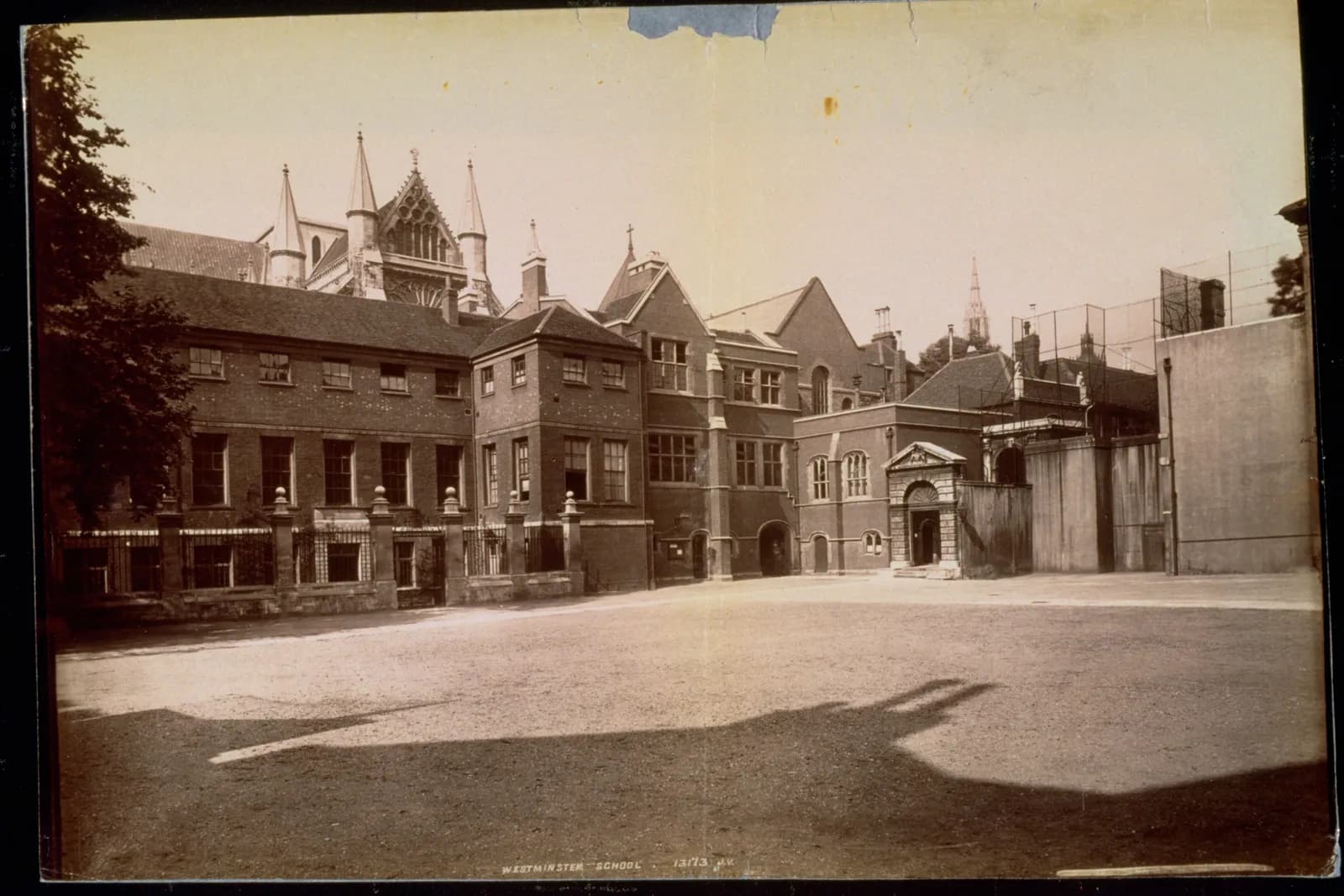
Westminster School stands within the precincts of Westminster Abbey at Little Dean's Yard. It is the only long-established school to remain on its original site in central London. The school occupies a UNESCO World Heritage Site surrounded by Westminster Abbey, St Margaret's Church, and the Palace of Westminster.
The school's survival was never guaranteed. When Henry VIII ordered the dissolution of the monasteries in 1540, he personally intervened to save Westminster School, establishing 40 "King's Scholars" financed from the royal purse. Elizabeth I refounded the institution in 1560, and the school generally marks 1560 as its founding date.
During the Blitz in 1941, the school roof was destroyed. Unlike Charterhouse and St Paul's, which evacuated, Westminster School refused to relocate. It remains on its original site today.
Seven Prime Ministers and Counting
The school has educated seven British Prime Ministers: Henry Pelham, the Duke of Newcastle, the Marquess of Rockingham, the Earl Waldegrave, the Duke of Grafton, the Duke of Portland, and Lord John Russell. Its alumni include philosopher John Locke, scientist Sir Christopher Wren, architect Robert Hooke, writers A.A. Milne and Edward Gibbon, and actors John Gielgud and Peter Ustinov.
Little Dean's Yard and Its Traditions
The school's private square, known simply as "Yard" to pupils, contains buildings spanning nearly a millennium. College Hall, the 14th-century abbot's dining hall, remains in daily use. Ashburnham House, dating from the mid-17th century, contains the school library. The School Gateway, built in 1734 by the Earl of Burlington, bears over 2,000 names carved by pupils since the 18th century.
Pupils attend services in Westminster Abbey twice weekly; the Abbey serves as the school chapel. Vincent Square, a 13-acre playing field half a mile distant, was created in 1810 and remains in use today. College Garden, adjacent to the school, has been under continuous cultivation for approximately 1,000 years.
From Single-Sex to Co-Educational
The school currently educates 778 pupils, with boys entering at 13 and girls joining at 16 for Sixth Form. From 2028, girls will be admitted at 13, and the school will be fully co-educational by 2030. Westminster Under School, the junior division, accepts pupils from age 7 and will expand to age 4 from 2026.
About a quarter of pupils board at the school. Academic results remain consistently among the highest nationally; approximately half of each year group proceeds to Oxford or Cambridge.