Tucked behind Westminster Abbey on Caxton Street, a single building witnessed Elizabeth Taylor's marriages, Emmeline Pankhurst's "Women's Parliament," and an Indian revolutionary's deadly revenge for colonial violence. This is the story of how one Westminster venue became an unlikely stage for revolutions, celebrity, and tragedy across nearly a century.
The Building: Victorian Civic Pride Meets Francois I Style
Caxton Hall opened in 1883 as "Westminster Town Hall," the seat of local government for St Margaret and St John parishes. Architects William Lee and F.J. Smith designed it in the ornate "Francois I style," using red brick and pink sandstone with slate roofs. The foundation stone was laid on 29 March 1882 by Baroness Burdett-Coutts, the Victorian philanthropist.
The building contained two public halls, the Great and York Halls, and served as the headquarters for the local vestry. It was renamed "Caxton Hall" in 1900 to commemorate William Caxton, the pioneering printer who worked nearby in Westminster Abbey's almonry during the 15th century.
The Suffragette Epicentre: When Caxton Hall Launched a Revolution
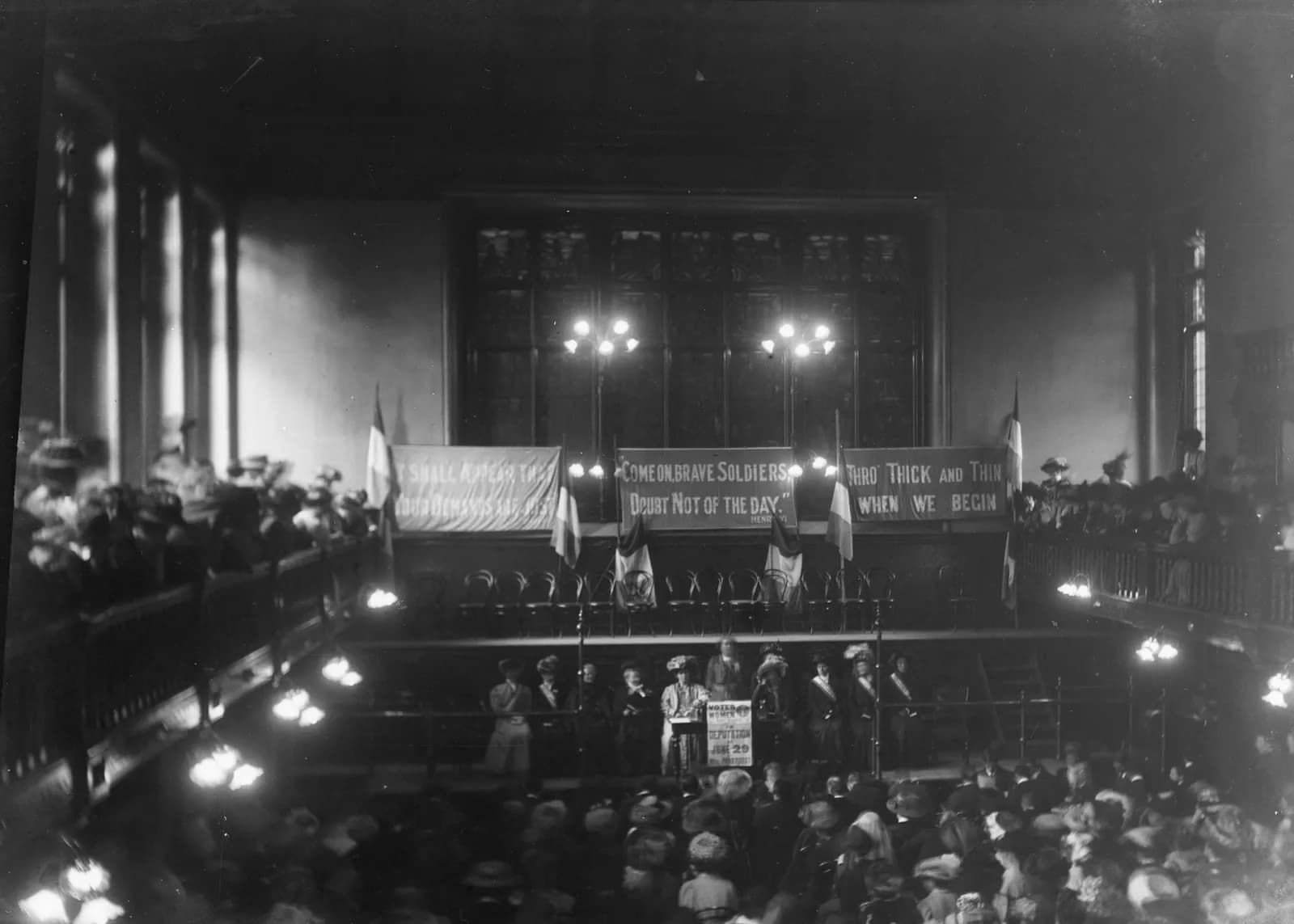
From 1907, Caxton Hall became the headquarters of the militant suffrage movement. The Women's Social and Political Union (WSPU), led by Emmeline Pankhurst, held a "Women's Parliament" at the beginning of each parliamentary session. After these meetings, suffragettes would march from Caxton Hall to the Houses of Parliament to attempt to deliver petitions to the Prime Minister. They were always turned away.
The most infamous of these marches occurred on 18 November 1910. Emmeline Pankhurst led 300 women from a pre-arranged meeting at Caxton Hall towards Westminster. They were met by police and roughly handled; the violence of that day became known as "Black Friday." Photographs from 1908 and 1909 show WSPU leaders, including Emmeline Pankhurst and Emmeline Pethick-Lawrence, addressing packed meetings from the platform at Caxton Hall.
Today, a bronzed scroll sculpture in nearby Christchurch Gardens commemorates Caxton Hall's central role in the militant suffrage movement.
Hollywood Glamour: The Post-War Celebrity Wedding Capital
In October 1933, Caxton Hall began a new chapter as Central London's register office. For the next 45 years, it became the most sought-after venue for civil marriages among high society and celebrities.
A roll call of the famous who married at Caxton Hall reads like a mid-century Who's Who: Elizabeth Taylor (on multiple occasions), Roger Moore, Peter Sellers, Joan Collins, Adam Faith, Donald Campbell, Yehudi Menuhin, and Ringo Starr. On 18 August 1952, future Prime Minister Anthony Eden married Clarissa Spencer-Churchill, niece of Winston Churchill, within its walls.
The register office closed in 1979, ending an era of celebrity glamour that had transformed the Victorian civic building into a stage for paparazzi and film stars.
Political Assassination: The 1940 Shooting of Sir Michael O'Dwyer
On 13 March 1940, Caxton Hall became the scene of an assassination that linked Westminster directly to the violence of the British Raj. Udham Singh, a 41-year-old Indian revolutionary and survivor of the 1919 Jallianwala Bagh massacre, entered the building during a joint meeting of the East India Association and the Central Asian Society.
Sir Michael O'Dwyer, the 75-year-old former Lieutenant Governor of Punjab (1913-1919), was due to speak. O'Dwyer had been responsible for the events in Amritsar on 13 April 1919, when British troops under Brigadier General Reginald Dyer opened fire on an unarmed crowd, killing hundreds.
Singh had concealed a revolver inside a book with pages cut in the shape of the weapon. As O'Dwyer moved towards the speaking platform, Singh shot him twice. One bullet passed through O'Dwyer's heart and right lung, killing him almost instantly. Louis Dane, Lord Zetland, and Lord Lamington were also wounded in the attack.
Singh made no attempt to escape and was arrested immediately. He was convicted of murder, sentenced to death, and hanged at Pentonville Prison on 31 July 1940. His motivation was revenge for the Amritsar massacre.
Other Historical Footnotes
Caxton Hall's roster of events reads as a catalogue of 20th-century British history. The First Pan-African Conference took place there in 1900. Aleister Crowley staged his "Rites of Eleusis" performances over six weeks in 1910. David Lloyd George outlined the Allies' war aims in a speech there in January 1918. During the Second World War, the Ministry of Information held press conferences at Caxton Hall attended by Winston Churchill, commemorated by a plaque unveiled in 1991.
The Russell-Einstein Manifesto press conference, warning of nuclear war threats, was held there in 1955. On 12 May 1960, the Homosexual Law Reform Society held its first public meeting at Caxton Hall, attracting over 1,000 attendees. Less than a decade later, on 7 February 1967, the National Front was founded at a meeting in the same halls.
What Remains: The Building Today
Caxton Hall closed as a register office in 1979 and stood empty for years, eventually placed on the Buildings at Risk Register. It was granted Grade II listed status on 15 March 1984 (listed building number 1357266), recognising its special architectural and historic interest.
In 2006, the building underwent redevelopment. The facade and former register office at the front, facing Caxton Street, were restored and converted into luxury flats, a process of "facadism" that preserves the historic exterior while redeveloping the interior. The original halls at the rear were demolished, and a circular office building named the "Astius Building" was constructed on the site.
The corner of Caxton Street and Palmer Street looks today like many other smart Westminster addresses. Passers-by might not notice the building where suffragettes planned their march on Parliament, where Elizabeth Taylor said "I do," and where an Indian revolutionary avenged a colonial massacre. But for those who know where to look, Caxton Hall remains a building where Westminster history was made, again and again.