A Medieval Fortress in the Heart of Westminster
The Jewel Tower stands as one of only four buildings to survive the catastrophic fire that destroyed the Palace of Westminster in 1834. This three-storey stone structure, tucked away in Old Palace Yard, offers Westminster residents a rare tangible link to the medieval royal palace that once dominated the area.
Built between 1365 and 1366 under the instruction of King Edward III, the tower was constructed to house the monarch's personal treasure, not the Crown Jewels which were kept at the Tower of London. Master mason Henry Yevele and master carpenter Hugh Herland directed the project, using 98 boat-loads of Kentish ragstone from Maidstone, 469 cart-loads from Reigate, and additional stone from Devon and Normandy. The result was a crenellated stone building with no ground-floor exterior windows; the only access was through an internal door protected by 18 locks.
The Fire of 16 October 1834
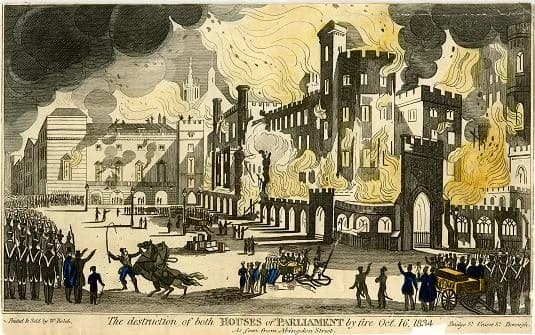
The blaze that destroyed the medieval Palace of Westminster began at approximately 5:00 PM on 16 October 1834. The cause was an overheated stove in the House of Lords chamber, where workmen Joshua Cross and Patrick Furlong were burning two cart-loads of wooden tally sticks, obsolete accounting tokens that had been used by the Exchequer since medieval times.
The workmen left the furnace doors open, creating an intense draft that overheated the flues. By 6:30 PM, a "giant ball of flame" had erupted. The fire spread rapidly through the wood-panelled narrow corridors of the palace. The roof of St Stephen's Chapel, which served as the House of Commons chamber, collapsed by 7:30 PM. The blaze raged through the night; a floating fire engine did not arrive until 1:30 AM, delayed by low tide.
The destruction was immense. The fire consumed the House of Lords, the Painted Chamber, Speaker's House, the House of Commons library, and most Commons records from the 15th century. It was, by contemporary accounts, the largest conflagration in London between the Great Fire of 1666 and the Blitz. Miraculously, there were no deaths, though nine people were hospitalised.
Why the Jewel Tower Survived
Several factors contributed to the Jewel Tower's survival while the palace around it burned. Its location, positioned slightly removed from the main Palace of Westminster in the secluded south-west corner, placed it away from the prevailing wind that fanned the flames eastward.
The tower was surrounded by a moat, linked to the River Thames by a 45-metre channel. This water-filled ditch provided a crucial fire break on the south and west sides. The thick Kentish ragstone walls offered natural fire resistance.
Perhaps most significantly, centuries of incremental fire-proofing had prepared the tower for exactly this disaster. A brick vault was added to the first floor in 1621 at a cost of £6 by Thomas Hicks; an iron door marked "IR" for James I was installed the same year. A brick partition was added between second-floor rooms in 1726, and a stone vault replaced the wooden ceiling on the first floor around 1753 at a cost of £350. These improvements, originally intended to protect the House of Lords records that had been stored there since the 1590s, proved decisive.
What Was Lost and What Remained
While the Jewel Tower survived with its contents intact, the surrounding destruction was profound. The fire destroyed the original standards of measurement; the yard and pound established in 1496 were lost to the flames. The House of Commons records stored in St Stephen's Chapel were largely destroyed, while the House of Lords records, safely housed in the Jewel Tower, survived.
The fire left Westminster Hall standing, along with only three other structures: the Jewel Tower, St Stephen's Undercroft, and St Stephen's Cloisters. These four survivors represent the only remaining architectural evidence of the medieval Palace of Westminster that once dominated the area.
From Treasury to Tourist Attraction
The Jewel Tower's role has shifted considerably over the centuries. After a fire destroyed the royal apartments in 1512, Henry VIII relocated to Whitehall Palace and the tower was repurposed for storing household effects. By the 1590s it had become a parliamentary records office, a function it served until 1864 when the documents were transferred to the newly constructed Victoria Tower.
Between 1869 and 1938, the building served as the Standard Weights and Measures Department. During this period the tower's thick stone walls were considered particularly suitable for scientific measurements. In 1941, an incendiary bomb destroyed the roof, but the structure was restored by the Ministry of Works, now English Heritage, and opened to the public in 1956.
Visiting the Jewel Tower Today
Today the Jewel Tower is managed by English Heritage as a tourist attraction. Located on Abingdon Street in Westminster, it receives approximately 30,000 visitors annually. The tower is open daily from 10:00 AM to 5:00 PM, with last entry at 4:30 PM.
Visitors can explore three floors of displays covering the royal wardrobe, the House of Lords archive, and the National Weights and Measures Office. Exhibits include 11th-century Westminster Capitals, an Anglo-Saxon Palace of Westminster Sword, Delftware drinking jars, and an Iron Age sword on loan from the Science Museum. Digital reconstructions show Westminster Hall, St Stephen's Church, and the Palace of Westminster as they appeared before the 1834 fire.
The tower holds Grade I listed status and is part of the Westminster UNESCO World Heritage Site, designated in 1987. It remains one of the few physical connections to medieval Westminster; a "precious vestige" of the area's royal and parliamentary history that has survived fire, bombing, and centuries of urban transformation.